What affects the cost of French polishing? Key factors for Surrey homeowners
By J Hardy French Polishing
What affects the cost of French polishing? Key factors for Surrey homeowners
French polishing remains the benchmark finish for antiques and bespoke furniture — a deep, glass-like shellac that modern lacquers rarely match. For Surrey homeowners considering restoration, cost isn't arbitrary: it reflects materials, repair work, skill and time. J Hardy French Polishing is a family-run workshop with 40 years' experience in traditional finishing; below is a clear breakdown of what drives cost and how to get an accurate quote.
1. Condition of the piece
- Surface damage: Deep scratches, water rings, burns or ink stains need more than a simple recoat. Repairs such as filling, steam-straightening or veneer patching add labour.
- Structural issues: Loose joints, missing mouldings or broken veneers must be fixed before finishing — otherwise the polish will fail quickly.
- Previous finishes: Old varnish or polyurethane often requires careful chemical or mechanical stripping. Shellac over lacquer can also cause adhesion problems that take time to address.
2. Size and complexity
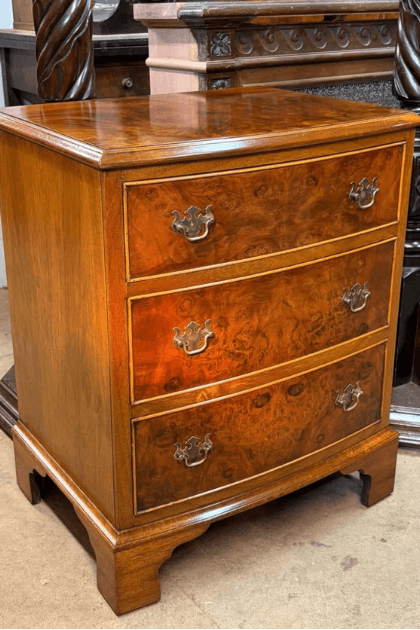
A chest of drawers is not the same as a carved Victorian sideboard. Costs rise with:
- Surface area to be worked on (flat panels vs. moulded legs)
- Intricate carving, fluting, reeding or inlays that need painstaking rubbing with a tamping pad
- Number of components (doors, drawers, spindles) that must be taken apart and worked on individually
3. Type of timber and veneering
Mahogany, walnut and other figured veneers respond differently to French polishing. Crotch mahogany, burr walnut and birds-eye maple demand careful handling to avoid raising the grain or altering figure. Where veneers are missing or damaged, re-veneering is specialist work and influences cost.
4. Preparation and repair work
Quality French polishing depends on proper preparation:
- Stripping or sanding old finishes
- Repairing veneers and re-gluing edges
- Filling open joints and matching grain or colour
- Steam and humidification to reverse cupping or warping
Each preparatory stage is skilled labour. A well-prepared substrate uses less shellac in the long run and gives a far superior finish, but it does add time and therefore cost.
5. Number of shellac coats and rubbing time
French polish is a build-up process. Multiple thin layers of shellac are applied, allowed to ‘open’ and then levelled with reposseur and oil. More coats equal more depth — but also more time for drying, inspection and rework where dust or pinholes appear. Expect the finishing stage to be the most labour-intensive.
6. Colour-matching and toning
Antique restoration often requires colour-matching to existing patina. Toning, grain staining and scumbles are applied before the finish to recreate an authentic look. This requires testing on a hidden panel and fine-tuning, which affects the time on site or in the workshop.
7. On-site work vs. workshop restoration
Small items (chairs, mirror frames) can often be finished on-site, but large items — stair balustrades, full staircases, fixed panelling or large fireplace surrounds — usually need workshop dismantling or full on-site set-up. On-site work may incur access and protection time, especially in occupied Surrey homes.
8. Accessibility and logistics
Ground-floor workshops in Guildford are straightforward; properties with restricted access, narrow staircases or conservation-area rules require more planning and protection, which increases labour and time.
9. Timescale and turn-around
French polishing can’t be rushed. Allow for drying times, between-coat checks and final curing. Urgent turnarounds or weekend/evening work to suit a homeowner’s schedule will typically affect quotes.
How Surrey homeowners can reduce surprises
- Accurate brief: Photograph the piece from all angles and describe previous treatments. Include details of structural issues.
- View examples: Ask to see before/after photos of recent French polishing work — particularly on similar woods or pieces.
- Test panel: Request a small test area or sample to confirm tone and sheen before full application.
- Prepare space: Clear access, protect carpets and remove delicate ornaments. This reduces on-site protection time.
- Consolidate work: Group multiple pieces or joinery jobs into one booking to avoid repeated visits.
Questions to ask before hiring
- What preparation does the piece need and can you show me the proposed repair plan?
- How many shellac coats do you typically apply for this timber/type of work?
- Do you work in a workshop or on-site, and what protection measures do you use in my home?
- Can you provide references or photos of similar work in Surrey (Guildford, Portsmouth, Corbyn areas)?
- What is the expected timescale and what factors might extend it?
Final thoughts
The cost of French polishing reflects craft, not cosmetics. When done correctly — with attention to timber, preparation and traditional shellac technique — the finish lasts and adds real character to period furniture and high-quality domestic joinery. For homeowners across Surrey who want honest, specialist advice, J Hardy French Polishing offers 40 years of family experience in French polishing, furniture restoration and upholstery. Contact J Hardy French Polishing to book an assessment and a written quotation tailored to your piece and property — expect a clear scope of work and a conservation-led approach rather than off-the-shelf fixes.